

Company Registration in Bulgaria
Gateway to the European Union – Complete Guide for Foreign Entrepreneurs
10% Corporate Tax
Full EU Membership
3–7 Business days to register
100% Remote Possible
Company Registration in Bulgaria at a Glance
Why Register a Company in Bulgaria?
Registering a company in Bulgaria gives foreign entrepreneurs a rare combination: the lowest corporate tax rate in the European Union, full access to the EU Single Market, share capital of one euro, and a registration process that can be handled entirely remotely, without travelling to Sofia. Since 1 January 2026 the country is part of the euro area, so a Bulgarian company invoices, banks and reports in euro exactly like a company in Dublin or Frankfurt. The route is the same whether you open a company in Bulgaria as a first step into the EU or are setting up a company in Bulgaria alongside an existing group – a notarised power of attorney and certified translations replace the trip. From the first month after incorporation the company files VAT returns and annual accounts, and that side is covered by our accounting services in Bulgaria. Below are the six reasons foreign founders give most often.
Lowest EU tax rate
Flat 10% corporate & personal income tax – One of the lowest corporate income tax rates in the EU
Full EU market access
Operate across 27 member states, access EU funding, free movement of services.
Remote-first setup
Registration, banking & accounting handled without visiting Bulgaria.
Low operating costs
Office space, skilled labour & professional services far cheaper than Western Europe.
70+ tax treaties
Double taxation agreements reduce withholding tax for international structures.
EU-standard compliance
Full GDPR & EU corporate law alignment. Bulgaria has been a full member of the Schengen Area since 1 January 2025.
Types of Companies You Can Register
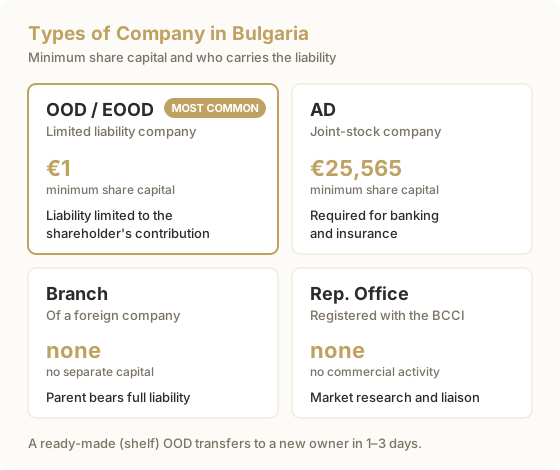
Bulgarian law provides several legal forms for conducting business, and this is the first decision of company formation in Bulgaria. The choice of structure depends on your business model, planned activities, number of shareholders, and capital requirements. Our advisors will recommend the optimal entity type during your free initial consultation.
| Type | Description & Key Facts |
|---|---|
| OOD / EOOD | Limited Liability Company Most popular for foreign founders. Minimum share capital: €1. Shareholders bear no personal liability beyond their contribution. Director may be a foreign national. Recommended for: IT · Trading · Consulting · E-commerce · Holdings |
| AD | Joint Stock Company For larger ventures & regulated sectors. Minimum share capital: €25,565 (BGN 50,000 converted at the fixed rate of 1.95583). Shares may be publicly or privately traded. Required for banking and insurance. Best for: Investment funds · Financial services · Large enterprises |
| Branch | Branch of a Foreign Company Extend your existing entity into Bulgaria without a new subsidiary. Parent company bears full liability. A local branch manager must be appointed. Best for: Market testing · Operational presence · Service delivery |
| Rep. Office | Representative Office Registered with the Bulgarian Chamber of Commerce and Industry (BCCI). Cannot conduct commercial activities – limited to market research, promotion, and liaison. Best for: Brand presence · Market research · Liaison functions |
| Shelf Co. | Ready-Made Company Pre-registered OOD with no prior activity or liabilities. Ownership transfer in 1–3 days – ideal when speed matters or a specific registration date is needed. Fast-track option for: Tenders · Immediate operations |
The Company Registration Process in Bulgaria – Step by Step
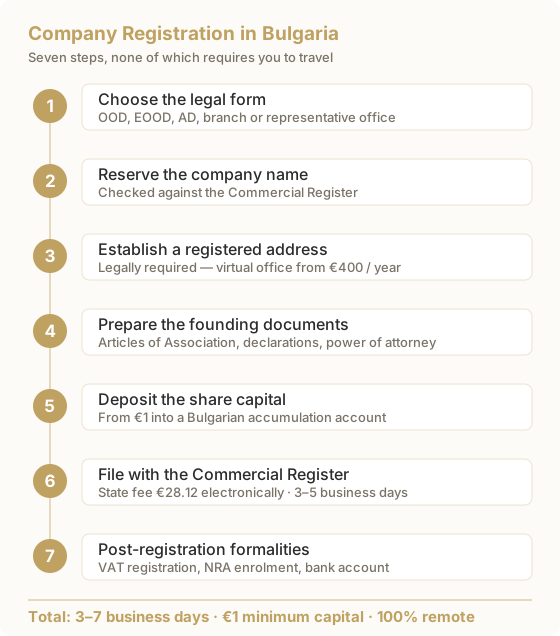
From first contact to a fully registered, operational Bulgarian company in as little as one week. Each step below is handled by our team – you only need to provide the required documents and approvals. This sequence is the whole answer to how to register a company in Bulgaria, and not one of the seven steps requires you to be in the country.
1 – Choose your legal form
Advisory
Our advisors assess your business model, planned activities, and shareholder structure to recommend the optimal entity type.
2 – Reserve your company name
Check availability
We check uniqueness against the Bulgarian Commercial Register and secure your preferred name.
3 – Establish a registered address
Virtual office available
Every Bulgarian company legally requires a local address. We provide legal address & virtual office services in Sofia, Plovdiv, Varna, and Burgas.
4 – Prepare founding documents
Drafted by legal team
Articles of Association, director declarations, and specimen signatures – drafted by our legal team. Remote founders use a notarized & apostilled Power of Attorney.
5 – Deposit share capital
From €1
Statutory minimum capital is deposited into a Bulgarian bank account. We assist with bank selection and capital deposit documentation.
6 – File with the Commercial Register
3–5 business days
The application is submitted to the Registry Agency. Registration confirmed within 3–5 business days.
7 – Post-registration formalities
VAT, NRA, Bank
VAT registration, NRA enrollment, bank account transition, and employment registration (if applicable) – all coordinated by our team.
Documents Required to Register an OOD
The documents you need to open a company in Bulgaria vary by legal form and the nationality of the founders. For an OOD registration by a foreign national, the following are typically needed. Our team prepares all templates and guides you through country-specific notarization and apostille requirements.
- Valid passport or national ID of all shareholders and the director
- Specimen signature of the director (notary-certified)
- Articles of Association / Memorandum of Association (drafted by our legal team)
- Bank certificate confirming share capital deposit
- Director’s declaration of criminal record & legal capacity
- Power of Attorney (for remote founders) – notarized & apostilled
What Company Registration in Bulgaria Costs
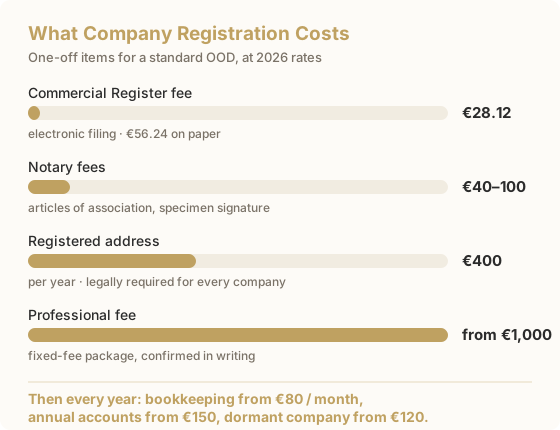
Company formation in Bulgaria is among the cheapest in the European Union. The table below shows a typical cost breakdown for registering an OOD. Costs for remote registration (involving Power of Attorney, apostille, and courier) will vary based on the founders’ country of origin.
| Item | Approximate Cost |
|---|---|
| Commercial Register fee for initial OOD/EOOD registration | €28.12 for electronic filing or €56.24 for paper filing. |
| Notary fees (Articles of Association, signatures) | €40–100 |
| Legal address / registered office (annual) | €400 / year |
| Bulgaria for Business VCC professional fee | From €1,000 |
| TOTAL – Typical OOD formation | From €1,000 |
What a Bulgarian Company Costs to Run Each Year
Setting up a company in Bulgaria is a one-off payment; the recurring cost is what decides whether the company is worth keeping. Accounting is legally mandatory for every Bulgarian company, a dormant one included – a company that traded nothing still files a nil annual tax return and simplified financial statements. The figures below are our published rates, excluding Bulgarian VAT.
| Recurring item | From |
|---|---|
| Registered address / virtual office | €400 / year |
| Bookkeeping – low-activity or newly registered company (up to 30 transactions) | €80 / month |
| Bookkeeping – growing company (up to 100 transactions) | €150 / month |
| Monthly VAT return, once the company is VAT-registered | €50 / month |
| Annual financial statements under Bulgarian National Accounting Standards | €150 / year |
| Filing with the National Statistical Institute (deadline 30 June) | €50 / year |
| Publication of the accounts in the Commercial Register (deadline 30 September) | €80 / year |
| Dormant company – nil annual report and zero-activity tax return | €120 / year |
Taxes a Bulgarian Company Pays
Corporate income tax is a flat 10% on profit – the lowest headline rate in the European Union and unchanged since 2007. VAT is 20% standard, with a 9% reduced rate for accommodation and books. Dividends distributed to individuals carry 5% withholding tax, while dividends paid to an EU parent company are normally exempt under the Parent-Subsidiary Directive. There is no municipal profit tax and no capital duty on incorporation. Rates, deadlines and the advance-payment rules are set out in full in our guide to taxes in Bulgaria in 2026.
| Tax and rate | What it applies to |
|---|---|
| Corporate income tax – 10% | Flat rate on worldwide profit. Annual return and payment by 30 June. |
| VAT – 20% standard, 9% reduced | Mandatory above €51,130 of domestic taxable turnover in a calendar year, voluntary from day one – see VAT registration in Bulgaria. |
| Withholding tax on dividends – 5% | On distributions to individuals and to non-EU companies. EU parent companies are normally exempt. |
| Personal income tax – 10% | Flat rate on the worldwide income of Bulgarian tax residents. |
| Social security and health – approx. 33% | Split between employer and employee on gross salary, up to a statutory monthly ceiling. |
Does Bulgaria tax foreign income?
Yes – but not twice. A Bulgarian company is taxed on its worldwide profit, so tax residence rather than the location of the customer decides where profit is declared. The country’s network of more than 70 double taxation treaties then prevents the same profit being taxed a second time, either by exempting the foreign income or by crediting the tax already paid abroad. Individuals who become Bulgarian tax residents are taxed on worldwide income at the same flat 10%.
Where the 10% rate stops applying
Groups with consolidated revenue above €750 million fall under the EU’s Pillar Two rules and pay an effective 15% in Bulgaria through a domestic top-up tax. Below that threshold – where practically every owner-managed company sits – the 10% applies in full. A separate risk is substance: a Bulgarian company with no real activity in Bulgaria is assessed by the tax authority of the country where its management actually sits, not by Bulgaria. Our tax law team reviews a structure before it is built rather than after it is questioned.
Bulgaria in the Euro Area Since 1 January 2026
Bulgaria joined the euro area on 1 January 2026 at the irrevocable rate of BGN 1.95583 to the euro, becoming its twenty-first member. Company registration in Bulgaria after that date carries nothing extra: share capital, state fees, accounts and invoices are stated in euro from the start, and there is no currency conversion step at any point in the procedure.
Companies registered before 2026 carry one obligation with a deadline. The share capital recorded in the Commercial Register was converted automatically and free of charge, and shareholdings kept their exact proportions – but the articles of association and the other founding documents must be brought into line with the euro amounts and filed with the register by 31 December 2026. Leaving it undone is not a fine, it is a discrepancy: the register and the company’s own documents state different figures, which is exactly what banks and counterparties check.
Opening a Corporate Bank Account in Bulgaria
Company incorporation in Bulgaria and the banking that follows it are two separate procedures, and the second is the slower one. Share capital is first paid into an accumulation account – a temporary, restricted account opened on the basis of the founding documents – and the bank issues the certificate that goes into the registration file. That account turns into an ordinary current account only after the company appears in the Commercial Register.
What slows the second stage is compliance, not paperwork. Bulgarian banks apply the same EU anti-money-laundering and know-your-customer rules as banks anywhere in the union, and a company with a foreign director and no local operations answers more questions than a local one: origin of the funds, planned activity, where the customers are, who the ultimate beneficial owner is. Allow one to three weeks after registration, expect either a personal visit or a video identification session depending on the bank, and prepare the ownership chain up to the beneficial owner in advance. Payment institutions are a faster fallback, but the tax authority and many Bulgarian counterparties still expect an IBAN held at a bank. Which bank actually suits a foreign owner is a separate question, and we compared them in this review of business accounts for non-residents.
Registering a Company in Bulgaria from Abroad
Foreign founders complete company registration in Bulgaria without setting foot in the country, and where you live changes the paperwork rather than the rights. There is no residency requirement, no local director, no local shareholder and no minimum investment – the same rules apply whether you are in London, New York, Dubai, Delhi or Istanbul. What differs is only how your power of attorney is legalised.
| Where you sign | How the power of attorney is legalised |
|---|---|
| EU or EEA country | Notarised locally. Many public documents circulate between member states without an apostille at all under Regulation 2016/1191. |
| Hague Apostille Convention UK, US, India, Turkey, UAE, Australia, most of Latin America |
Notarised, then apostilled by the designated authority in that country. No consulate is involved and the file travels by courier. |
| Outside the Convention | Notarised, then legalised through the Bulgarian embassy or consulate. The same result, but allow an extra one to three weeks. |
A certified Bulgarian translation is required in every case, and we arrange it here rather than sending you to look for a translator locally.
Two things catch foreign founders out regardless of nationality. An existing company abroad cannot simply be moved to Bulgaria: you either register a new Bulgarian entity or open a branch of the existing company, and the two differ in liability and in reporting. And a foreign address with foreign tax residence means more compliance questions at the banking stage, so allow extra time there. Everything else – the €1 of capital, the 3–7 business days, the flat 10% corporate tax – applies identically.
Does a Bulgarian Company Give You Residence?
Owning a Bulgarian company and living in Bulgaria are two different things, and treating them as one is the most common misunderstanding we correct. Citizens of the EU, the EEA and Switzerland need no permission at all – they register their residence with the migration authorities after ninety days and that is the whole procedure. Everyone else needs a long-stay D visa, applied for at a Bulgarian consulate in the country of residence, before any residence permit can be issued. The visa types and the documents each one needs are set out in our guide to obtaining a Bulgarian visa.
Company ownership by itself does not qualify a non-EU founder for that visa. The routes that do exist are narrower than they look – employment as the company’s own manager, a trade representative office registered with the Bulgarian Chamber of Commerce and Industry, or an investment-based permit – and each carries its own conditions on activity, headcount or capital. None of them follows automatically from a company existing on paper. Because the choice of legal form can close some of these routes, the question is worth settling before registration rather than after.
Checking a Company in the Bulgarian Commercial Register
Every Bulgarian company is public, and the Bulgarian company register is where that record lives. The Commercial Register and Register of Non-Profit Legal Entities, maintained by the Registry Agency, publishes each company’s UIC, legal form, registered address, managers, shareholders, share capital and every document ever filed, annual financial statements included. Search is free, needs no account and works by company name or by UIC at portal.registryagency.bg.
The UIC – a nine-digit unified identification code, still widely called the BULSTAT number – identifies the company everywhere: on invoices, in bank forms, in contracts. A VAT-registered company additionally holds a VAT number, which is the same digits with a BG prefix. Entities that are not merchants, such as foundations and branches of foreign persons, are entered in the separate BULSTAT register instead. When you check a counterparty before signing, three things repay the two minutes it takes: whether the annual accounts are filed and current, whether the managers on file are the people you are actually dealing with, and whether there are pending applications not yet entered – the register shows those as well.