

MiCA (Markets in Crypto Assets Regulation – EU Regulation 2023/1114) is the EU’s comprehensive regulatory framework for crypto asset markets. It creates a single EU-wide regulatory regime for crypto asset service providers (CASPs) and crypto asset issuers. MiCA became fully applicable on 30 December 2024 for CASPs providing services across the EU. Titles III and IV (covering ARTs and EMTs) applied from 30 June 2024. CASPs that were operating before MiCA’s full application may benefit from transitional provisions in their home member state.
Crypto License in Bulgaria
MiCA CASP Authorisation – One Crypto License for Crypto Asset Services Across the Entire European Union
A crypto license in Bulgaria is a MiCA CASP authorisation issued by the Financial Supervision Commission (FSC) under EU Regulation 2023/1114 and the Bulgarian Markets in Crypto-Assets Act, in force since 4 July 2025. It requires a Bulgarian company with own funds of €50,000 to €150,000 depending on the service class, and the FSC has 40 working days to assess a complete application. Since 1 July 2026 no crypto asset service may be provided in Bulgaria without it.
A Bulgarian crypto license is issued only to a locally registered company, so the route starts with company formation in Bulgaria and continues with the AML and GDPR compliance framework the regulator expects to see in place.
EU MiCA Regulation
FSC Regulated
Full EU Passporting
From €50,000 Capital
Crypto licence in Bulgaria at a glance
€50K Min. capital – Class 1 CASP
€125K Min. capital – Class 2 CASP
€150K Min. capital – Class 3 CASP
27 EU member states – single licence coverage
Regulator – the Financial Supervision Commission (FSC). Legal basis – EU Regulation 2023/1114 (MiCA) and the Bulgarian Markets in Crypto-Assets Act. Statutory assessment – 40 working days from a complete application, after a 25-working-day completeness check. Corporate tax on profit – a flat 10%, the lowest rate in the EU. Everything below explains what the Bulgaria crypto license covers, what it costs and how long it takes.
Crypto regulation in Bulgaria
Crypto regulation in Bulgaria rests on two instruments that work together. The EU Markets in Crypto Assets Regulation (MiCA – Regulation 2023/1114) applies in full since 30 December 2024 and sets the same rules for crypto asset service providers (CASPs) in all 27 member states – which is why the Bulgarian permit is often called simply a MiCA license. The Bulgarian Markets in Crypto-Assets Act, adopted on 20 June 2025 and promulgated in the State Gazette on 4 July 2025, adds what a regulation cannot: it names the FSC as supervisor, sets the national procedure and fees, and fixes the deadline by which existing operators had to be licensed.
A Bulgarian CASP authorisation under MiCA is issued by the Financial Supervision Commission (FSC) and provides a single EU-wide licence – enabling the holder to provide authorised crypto asset services across all 27 EU member states through the MiCA passporting mechanism, without obtaining separate national licences in each country. Bulgaria offers a cost-competitive environment for establishing the required substance, combined with a 10% flat corporate tax rate and an established financial services regulatory framework.
WHO SUPERVISES CASPs IN BULGARIA: MiCA itself is directly applicable and needs no transposition, but Bulgaria still passed its own Markets in Crypto-Assets Act to put it into operation. The Act designates the Financial Supervision Commission as the National Competent Authority: it authorises CASPs, keeps the national register that the National Revenue Agency used to maintain, and supervises authorised firms alongside ESMA. The Bulgarian National Bank supervises issuers of e-money tokens. Penalties for operating without authorisation reach the higher of roughly €2.5 million or 6.25% of global annual turnover, so the licence is not a formality that can wait.
THE GRACE PERIOD IS OVER: Providers recorded in the Bulgarian AML register as virtual asset service providers (VASPs) before 30 December 2024 were allowed to keep operating without a licence until 1 July 2026. That transitional regime has ended. A former VASP that has not obtained CASP authorisation may no longer provide crypto asset services in Bulgaria, and a new entrant has no grace period at all – authorisation comes before the first client.
Which crypto assets MiCA covers
MiCA covers three categories of crypto assets, each subject to a different regulatory regime. Understanding which category your tokens or assets fall into is the first step towards a crypto license in Bulgaria: it decides whether you need a CASP authorisation at all, and which class of it.
| Crypto asset type | Description | MiCA treatment & requirements |
|---|---|---|
| Asset-referenced tokens (ARTs) | Crypto assets that maintain a stable value by referencing multiple currencies, commodities, or other crypto assets. Similar to multi-currency stablecoins. | Most stringent MiCA requirements – significant capital, reserve, and governance obligations. Issuers must be authorised credit institutions or obtain specific MiCA authorisation. |
| E-money tokens (EMTs) | Crypto assets that reference a single official currency – essentially electronic money issued on a blockchain (e.g. EUR stablecoins). | Must be issued by a credit institution or an e-money institution. The EMT regime largely follows existing e-money regulation under PSD2. |
| Other crypto assets (CASP scope) | All other crypto assets not qualifying as ARTs or EMTs – including utility tokens, payment tokens, and most major cryptocurrencies (Bitcoin, Ethereum, etc.). | Issuers subject to whitepaper requirements. Service providers (CASPs) require authorisation for any of the 10 services listed above. |
The ten crypto asset services that need CASP authorisation
MiCA defines ten specific crypto asset services that require CASP authorisation. A CASP license in Bulgaria is granted for a named subset of them, not for all ten at once. A CASP authorisation must specify which services the entity is authorised to provide – the scope is service-specific and cannot be exceeded without a variation of authorisation. The minimum capital requirement depends on the highest-class service the CASP is authorised to provide.
| Crypto asset service (MiCA Art. 3) | Description | Capital class |
|---|---|---|
| Custody & administration of crypto assets on behalf of clients | Safekeeping private keys or otherwise holding crypto assets on behalf of third parties. Includes operation of wallets, vaults, and similar custody infrastructure. | Class 2 · €125,000 |
| Operation of a crypto asset trading platform | Operating a multilateral system (exchange) where multiple third-party parties buy and sell crypto assets – order books, matching engines, or quote-driven platforms. | Class 3 · €150,000 |
| Exchange of crypto assets for fiat currency | Buying and selling crypto assets against fiat currencies (EUR, USD, GBP etc.) using own capital – acting as a dealer or market maker in crypto/fiat pairs. | Class 2 · €125,000 |
| Exchange of crypto assets for other crypto assets | Buying and selling crypto assets against other crypto assets using own capital – crypto-to-crypto swap and exchange operations. | Class 2 · €125,000 |
| Execution of orders in crypto assets on behalf of clients | Executing client orders to buy or sell crypto assets – acting as a broker rather than a principal. | Class 1 · €50,000 |
| Placing of crypto assets | Offering crypto assets to third parties on behalf of the issuer (underwriting or best efforts distribution) – relevant for token issuers and advisors. | Class 1 · €50,000 |
| Reception and transmission of orders in crypto assets (RTO) | Receiving a client order in crypto assets and transmitting it to another CASP for execution – an introducing or referral model. | Class 1 · €50,000 |
| Providing advice on crypto assets | Providing personalised recommendations to clients on specific crypto assets or crypto asset services. | Class 1 · €50,000 |
| Providing portfolio management of crypto assets | Managing portfolios of crypto assets on a discretionary basis on behalf of clients. | Class 1 · €50,000 |
| Providing transfer services for crypto assets on behalf of clients | Transferring crypto assets from one DLT address or account to another on behalf of clients. | Class 1 · €50,000 |
IMPORTANT – CASP AUTHORISATION SCOPE: A CASP authorisation is not a blanket licence to provide all crypto asset services. The FSC authorises specific services from the list above. If a CASP wishes to add services after authorisation, it must apply for a variation of its authorisation. Bulgaria for Business VCC advises on the optimal service scope to include in the initial application – balancing current business needs with anticipated growth.
What the FSC requires from a CASP applicant in Bulgaria
The application for a crypto license in Bulgaria requires a comprehensive package of documentation demonstrating that the applicant meets all regulatory requirements. The FSC reviews applications against the MiCA Regulation directly and against ESMA’s regulatory technical standards. A well-prepared application is essential to avoid delays from supplementary questions.
- Registered Bulgarian legal entity – a Bulgarian OOD or AD; the legal form depends on the specific services and capital class. Bulgaria for Business VCC advises on the optimal entity type for the intended CASP services.
- Minimum own funds / capital – Paid-up capital meeting the class requirement: €50,000 (Class 1), €125,000 (Class 2), or €150,000 (Class 3). Must be held in a Bulgarian bank account. May also be maintained as professional indemnity insurance of equivalent coverage.
- Management: fit & proper – management body members must demonstrate honesty, integrity, sufficient knowledge and experience of crypto asset services (or financial services more broadly). Criminal record clearance required. FSC assesses fitness and propriety of each proposed manager.
- Business plan & whitepaper – Detailed business plan describing the CASP’s services, target markets, technology infrastructure, financial projections, and compliance approach. Where the CASP is also a crypto asset issuer, a MiCA-compliant whitepaper is required.
- Policies & procedures – Documented policies covering: conflicts of interest, market abuse prevention, complaints handling, client asset segregation (where applicable), business continuity, and outsourcing arrangements.
- AML/CFT compliance programme – fully documented AML/CFT programme, mandatory for all CASPs under the EU Travel Rule and AML Directives as applied to crypto asset service providers. PEP screening, transaction monitoring, and suspicious transaction reporting.
- Technology & cybersecurity assessment – Description of the technology infrastructure, custody arrangements (where applicable), cybersecurity framework, wallet management, key management, and resilience/recovery procedures.
- Client asset segregation – for CASPs holding client crypto assets or fiat money: documented procedures for segregating client assets from own assets and maintaining accurate client position records.
- Physical presence in Bulgaria – a genuine operational presence: a physical office, usually in Sofia where the FSC and the banks are, with staff and infrastructure that match the business plan. The FSC expects real substance, not a letterbox: see legal address and office options.
AML FOR CRYPTO: CASPs are obliged entities under EU AML Directives and face some of the most demanding AML requirements in the financial sector – including blockchain transaction monitoring, Travel Rule compliance, enhanced due diligence for high-risk wallets, and screening against sanctions lists including OFAC, EU, and UN sanctions. A generic financial services AML policy is not enough here: the programme has to be crypto-specific. Bulgaria for Business VCC designs crypto-specific AML programmes including blockchain analytics tool integration from €2,000.
How to obtain a crypto license in Bulgaria
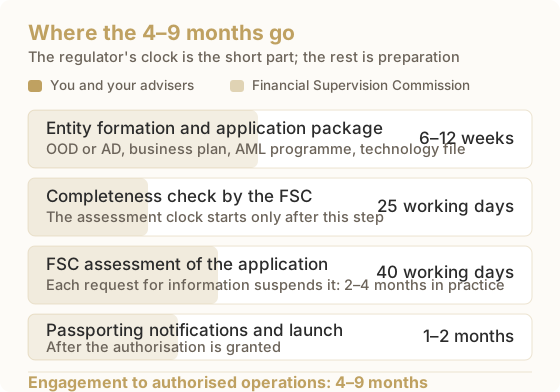
From the first assessment to authorised operations, Bulgaria for Business VCC manages the whole process of obtaining a crypto license in Bulgaria. The realistic timeline from engagement to authorisation is 4–9 months. The regulator’s own clock is short: 25 working days to confirm the application is complete and 40 working days to assess it, so nearly all of the elapsed time is preparation and answering supplementary questions.
1
MiCA scope & services assessment
We assess your business model against MiCA’s 10 service definitions and three asset type categories. We confirm which services require CASP authorisation, which capital class applies, and whether any activities fall outside MiCA’s scope (NFTs, DeFi, pure spot transactions).
Free initial assessment – 1–3 business days
2
Entity formation
Formation of the Bulgarian company that will hold the crypto license – OOD or AD depending on the services and capital class. Articles of Association, director appointment, share capital deposit, and Commercial Register registration.
2–4 weeks
3
Application documentation preparation
Preparation of the full MiCA application package: business plan, financial projections, compliance manual, AML programme (including blockchain analytics and Travel Rule solution), technology assessment, management CVs, policies and procedures, and whitepaper (if applicable).
4–8 weeks
4
FSC pre-application engagement
Where appropriate, we engage with the FSC in a pre-application meeting to confirm the application approach, discuss any novel aspects of the business model, and clarify FSC expectations before formal submission.
Optional but recommended for novel business models
5
Application submission to FSC
The complete MiCA CASP authorisation application is submitted to the FSC. The FSC has 25 working days to confirm the application is complete; only then does the assessment clock start.
Submitted within 1 week of final package
6
FSC review & supplementary questions
The FSC assesses a complete application within 40 working days and notifies its decision within 5 working days of taking it. In practice the calendar runs longer, because each request for supplementary information suspends the clock. We manage all FSC correspondence – preparing well-framed responses that address the regulator’s concerns concisely and completely.
40 working days statutory, 2–4 months in practice
7
CASP authorisation issued
The FSC grants the crypto license and completes the CASP registration in Bulgaria – the firm appears in the FSC register and in ESMA’s EU-wide public register of authorised CASPs. The authorisation specifies the services the CASP is authorised to provide.
Published in ESMA’s CASP register upon authorisation
8
Passporting & launch
EU passporting notifications to target member states, final compliance systems testing, and launch of authorised operations. Transition from application mode to full ongoing compliance regime.
1–2 months post-authorisation
Ongoing obligations after CASP authorisation
A crypto license in Bulgaria is not a one-off formality: being authorised as a CASP carries substantial ongoing obligations. These are not administrative formalities – regulators actively supervise CASPs and have powers to suspend or revoke authorisation for non-compliance. Bulgaria for Business VCC provides ongoing compliance support for all CASP clients.
| Ongoing obligation | Details |
|---|---|
| Own funds maintenance | Ongoing maintenance of minimum own funds. Immediate notification to FSC if own funds fall below the required minimum. Regular own funds calculations and reporting. |
| Prudential reporting to FSC | Periodic prudential reports to the FSC covering own funds, risk exposures, and compliance with MiCA requirements. |
| AML ongoing compliance | Continuous customer due diligence, transaction monitoring using blockchain analytics tools, Travel Rule compliance for crypto transfers, suspicious activity reporting to DANS. |
| Travel Rule compliance | Under FATF Travel Rule (implemented in EU via TFR Regulation), CASPs must transmit originator and beneficiary information with crypto asset transfers above €1,000. Requires Travel Rule solution integration. |
| ICT resilience under DORA | Regulation (EU) 2022/2554 (DORA) has applied to crypto-asset service providers since 17 January 2025: an ICT risk management framework, classification and reporting of ICT incidents, digital operational resilience testing, and contractual control over critical ICT third-party providers. |
| Market abuse prevention | Monitoring and prevention of market manipulation and insider dealing in crypto asset markets – obligations similar to MAR for traditional financial instruments. |
| Client disclosure obligations | Pre-contractual and ongoing disclosure to clients on fees, conflicts of interest, risks, and complaint procedures. Complaints handling with defined response timeframes. |
| Annual statutory audit | Annual statutory audit by a licensed Bulgarian auditor – audited financial statements submitted to the FSC. |
| Regulatory change monitoring | Ongoing monitoring of ESMA MiCA guidance, FSC regulatory developments, and EU AML Directive changes affecting CASPs – implementing required policy updates. |
| Supervision and penalties | The FSC may suspend or withdraw the authorisation. Administrative fines under the Bulgarian Markets in Crypto-Assets Act reach the higher of roughly €2.5 million or 6.25% of global annual turnover for a first offence – the practical reason ongoing compliance is budgeted, not improvised. |
| Accounting and tax filings | Bulgarian statutory accounting, monthly filings and the annual corporate tax return at the flat 10% rate. Handled together with the licence by our accounting team. |
Crypto license cost in Bulgaria
The Bulgaria crypto license cost splits into three parts that are easy to confuse: one-off application costs, a minimum capital commitment, and ongoing annual compliance costs. All professional fees exclude Bulgarian VAT (20%).
| Item | Description | Cost (excl. VAT) |
|---|---|---|
| Company formation (OOD or AD) | Formation of the Bulgarian entity – Articles of Association, director, share capital deposit, and Commercial Register filing. | From €300 |
| FSC application fee (state fee) | Official application fee payable to the FSC upon submission of the CASP authorisation application. | Class 1: €5,113; Class 2: €10,226; Class 3: €30,678 |
| Bulgaria for Business VCC – application preparation | Full application package: business plan, organisational policies, AML programme, technology assessment, management CVs, compliance manual, and all supporting documentation. | From €4,000 |
| AML compliance programme (crypto-specific) | Crypto-focused AML/CFT programme including blockchain analytics tool integration, Travel Rule solution, and transaction monitoring procedures. | From €2,000 |
| Legal address & physical office setup | Physical presence in Bulgaria – legal address and office arrangement advisory. | From €400/yr |
| Minimum own funds – Class 1 | Paid-up capital or equivalent professional indemnity insurance – regulatory capital commitment. | €50,000 |
| Minimum own funds – Class 2 | Paid-up capital for Class 2 services including custody, exchange, and crypto-to-crypto trading. | €125,000 |
| Minimum own funds – Class 3 | Paid-up capital for operating a crypto asset trading platform. | €150,000 |
| Ongoing compliance support (annual) | Post-licence compliance: FSC reporting, AML review, Travel Rule monitoring, policy updates, regulatory change management. | From €1,500/mo |
| Annual statutory audit | Annual statutory audit by a licensed Bulgarian auditor. | From €2,500/yr |
Minimum own funds are a regulatory capital commitment – a balance sheet item, not a fee. They must be maintained at all times. Professional indemnity insurance of equivalent value may substitute for paid-up capital in some cases – we advise on this option at the assessment stage. Official FSC fees are paid directly to the regulator and are not included in Bulgaria for Business VCC service fees. State fees were set in the Act in Bulgarian lev (BGN 10,000 / 20,000 / 60,000) and are shown here in euro at the fixed rate of BGN 1.95583 – Bulgaria adopted the euro on 1 January 2026 and the lev ceased to be legal tender on 1 February 2026.
Frequently asked questions about a crypto licence in Bulgaria
Key questions answered for foreign entrepreneurs planning to obtain a crypto license in Bulgaria – the CASP authorisation issued by the FSC.
Yes. Under MiCA, a CASP authorisation granted by the FSC in Bulgaria can be passported across all EU member states – allowing the CASP to provide its authorised services to clients in other member states either on a cross-border basis or through a branch, without obtaining separate national licences. The passporting notification process involves informing the FSC, which notifies the host state’s competent authority.
Bitcoin, Ethereum, and the vast majority of cryptocurrencies fall into MiCA’s ‘other crypto assets’ category – they are neither ARTs nor EMTs. Providing services in relation to these assets requires CASP authorisation under MiCA. NFTs (non-fungible tokens) are generally outside MiCA’s scope unless they are fungible in practice. DeFi protocols and fully decentralised systems without an identifiable service provider are also generally outside MiCA’s scope.
No – not without authorisation. Bulgaria used the full transitional period allowed by MiCA: a provider entered in the national AML register as a virtual asset service provider before 30 December 2024 could continue the registered activity until 1 July 2026. That date has passed, and the exemption with it. Continuing to serve clients without CASP authorisation now exposes the company to withdrawal of the register entry and to fines of up to roughly €2.5 million or 6.25% of turnover. If you are in this position, the application is still the way back – the entity, the capital and much of the AML documentation already exist, which usually shortens preparation to 4–6 weeks. Note also that the register itself moved: it is now kept by the FSC, not by the National Revenue Agency.
Three figures make up the answer. The state fee to the FSC is EUR 5,113 for Class 1, EUR 10,226 for Class 2 and EUR 30,678 for Class 3. Own funds are EUR 50,000, EUR 125,000 or EUR 150,000 for the same classes – a balance sheet commitment, not a payment. Professional work on the application starts from EUR 4,000, with the crypto-specific AML programme from EUR 2,000 and company formation from EUR 300. Running costs afterwards – compliance support from EUR 1,500 a month and the annual audit from EUR 2,500. The full breakdown is in the cost table above.
The statutory clock is 40 working days to assess a complete application, plus 25 working days before that for the FSC to confirm the file is complete, plus 5 working days to notify the decision. Every request for supplementary information suspends the clock, which is why a well-prepared file matters more than any other single factor. Counting from engagement (entity formation, capital, documentation and the FSC review together), plan for 4–9 months.
The applicant must be a Bulgarian legal entity – an OOD or an AD. It can be incorporated from scratch in 2–4 weeks, or you can start from a ready-made company where a few days matter. What cannot be bought is the authorisation itself: a CASP licence is granted to a specific firm for a specific list of services and cannot be transferred with the shares without the FSC assessing the new owners. Offers of a «crypto licence for sale» in Bulgaria mean, at best, a shelf company that still has to go through the full application.
The FATF Travel Rule, implemented in the EU through the Transfer of Funds Regulation (TFR), requires CASPs to obtain, hold, and transmit originator and beneficiary information with every crypto asset transfer of €1,000 or more. This applies to transfers between CASPs and to unhosted wallets (private wallets). Compliance requires implementation of a Travel Rule solution – technology that enables structured data exchange between CASPs. Bulgaria for Business VCC advises on Travel Rule compliance and technology provider selection as part of the AML programme.
A CASP is an entity providing services in relation to crypto assets – exchanges, custodians, brokers, portfolio managers. A crypto asset issuer is an entity that creates and offers crypto assets to the public (via a whitepaper). The same entity can be both an issuer and a CASP. Issuers of ‘other crypto assets’ must publish a MiCA-compliant whitepaper and comply with issuer conduct obligations – but do not require separate CASP authorisation for the issuance itself.
Under MiCA, all CASP authorisations are issued under the same EU-level regulatory framework – so the substantive requirements are identical regardless of which EU member state issues the licence. The key differences between jurisdictions are: the regulator’s processing speed and communication approach, the cost of establishing genuine substance, and the broader business environment. Bulgaria offers competitive operational costs and a flat 10% corporate tax rate, the lowest in the EU, and the same FSC handles investment firm licensing if the group later adds regulated financial services. Lithuania has been a popular early-mover jurisdiction. Germany’s BaFin has a more intensive supervisory approach. Bulgaria for Business VCC advises on jurisdiction selection as part of the regulatory assessment service.
Non-fungible tokens (NFTs) are generally outside the scope of MiCA – the regulation explicitly excludes crypto assets that are unique and not fungible with other crypto assets. However, if NFTs are issued in a large series where individual tokens are effectively interchangeable, or if they are used as payment instruments or investment vehicles, they may fall within MiCA’s scope. Bulgaria for Business VCC provides specific advice on the MiCA classification of NFTs and related token structures on a case-by-case basis.
Who already holds a CASP licence in Bulgaria
Four companies held a CASP authorisation from the Financial Supervision Commission on 4 September 2026. The register is public, so a provider that says it is licensed in Bulgaria can be checked against it in under a minute.
| Company | UIC | Authorised services | FSC decision |
|---|---|---|---|
| Alaric Securities OOD Sofia, also an investment firm |
201482151 | Eight of the ten services: custody and administration, exchange for funds, exchange for other crypto-assets, execution of orders, placing, reception and transmission of orders, advice, portfolio management | 783-ДУКА of 22 December 2025 |
| Belayer LTD Sofia |
204792388 | Custody and administration, execution of orders, portfolio management | 276-ДУКА of 28 April 2026 |
| Altcoins BG EOOD Varna |
205491943 | Custody and administration, exchange for funds, exchange for other crypto-assets, transfer services on behalf of clients | 499-ДУКА of 21 July 2026 |
| Digital Assist OOD Sofia |
206079266 | Exchange of crypto-assets for funds | 500-ДУКА of 21 July 2026 |
The list says two useful things about timing and scope. The first authorisation went to a company that already held an investment firm licence and came through in December 2025; the next three followed in April and July 2026, so decisions arrive one at a time rather than in batches. Scope varies just as much: Digital Assist is authorised for a single service, Alaric Securities for eight, and it is the application that fixes which of the ten CASP services the licence will cover.
Before signing anything with a provider, check its status in the three registers below: the first two are kept by the FSC in Sofia, the third by ESMA for the whole EU.
- FSC register of licensed crypto-asset service providers – the four companies above, with the services and the decision number for each
- FSC register under § 5(3) of the Crypto Asset Markets Act – companies still operating under the transitional regime rather than a full licence. The list itself is published in Bulgarian only
- ESMA databases and registers – the EU-wide MiCA register of authorised providers and white papers, and the separate list of entities ESMA flags as non-compliant
Sources and legal basis
Capital thresholds, deadlines and service classes on this page are taken from the regulation and the national act themselves, not from secondary summaries.
- Regulation (EU) 2023/1114 (MiCA) – the regulation on EUR-Lex. Title V sets the authorisation regime for crypto-asset service providers and the own funds requirement by class
- Markets in Crypto-Assets Act (Закон за пазарите на криптоактиви) – promulgated in State Gazette No 54 of 4 July 2025 under Presidential Decree No 105 of 27 June 2025
- § 3 of the transitional provisions of that Act: a provider registered before 30 December 2024 may keep operating without a licence until 1 July 2026, or until the FSC decides on its application if that comes first
- Financial Supervision Commission – the competent authority that grants the authorisation, maintains the public register of licensed providers and collects the state fees
- Regulation (EU) 2022/2554 (DORA) – in force since 16 January 2023 and applicable since 17 January 2025, per ESMA. It sets the ICT resilience requirements a CASP has to meet after authorisation
- FSC register of licensed crypto-asset service providers – the source for the four authorisations listed above, checked on 4 September 2026
Figures reviewed on 24 August 2026. The State Gazette publication and § 3 of the transitional provisions were re-checked on 2 September 2026. ESMA continues to publish technical standards and the FSC is still building its supervisory practice, so thresholds and timelines are worth confirming before you file – talk to our team.
Start your crypto license application in Bulgaria
Free regulatory assessment – we confirm the right service class for your business model, outline what the FSC will expect, and give a fixed-fee proposal for obtaining your crypto license in Bulgaria.
Class 1 from €50,000
Class 2 from €125,000
Class 3 from €150,000
Application support from €4,000
Class 2 from €125,000
Class 3 from €150,000
Application support from €4,000
Bulgaria for Business VCC – Your Trusted Partner for Business Expansion into Bulgaria and the European Union. MiCA requirements, capital thresholds, state fees and regulatory timelines are stated as of 24 August 2026 and are subject to change as ESMA publishes further technical standards and the FSC develops its supervisory practice. This page is for general information only and does not constitute legal or regulatory advice.
Last reviewed: 4 September 2026 · Sources and legal basis